SubAssist: Building Trade Office Automation Product
Market Problem:
In production residential construction, subcontractors like plumbers and electricians work with large home builders to deliver hundreds of homes. For each unit of work, subs receive a Purchase Order (PO). These POs have a 5 percent or higher error rate and must be manually reviewed and entered into accounting systems. This process is slow and repetitive. On top of that, field teams spend up to 25 percent of their time ordering supplies for each job, which cuts into productivity.
Who’s it for:
Construction Trades, Small Businesses
What we did:
SubAssist is a SaaS product built to automate back-office workflows for subcontractors working with production builders. I was brought in to lead development after six months of slow progress under an outsourced dev team. The founder needed help turning his vision into a working product.
To get the project back on track, I defined a clear roadmap with milestones, then worked closely with the team to execute on those goals. We partnered with a major industry player and prepared the product for market.
We launched with a group of early adopters within nine months and iterated based on feedback. We focused on three core use cases:
-
Managing digital versions of paper contracts
-
Automatically reconciling purchase orders
-
Ordering job-specific supplies without manual input
As part of the go-to-market effort, we worked with major suppliers in specific trades and developed a messaging strategy to target business owners in the building trades.
Success metrics:
- 3 paying customers within 18 months, generating more than $20K in ARR
-
Over $15,000 in monthly PO errors identified per customer
-
$100 million estimated impact by a national industrial supply partner ready to engage
SubAssist Dashboard
HomeBack to Products
Onward Financing: Mortgage for Movers Home Loan Product
Market Problem:
In residential real estate, existing homeowners face a major disadvantage in a competitive seller’s market. Conventional loans require paying off the current mortgage before closing on a new home, making these buyers less attractive due to the contingency.
Selling their current home becomes the only option, but coordinating two large, complex financial transactions across multiple parties introduces friction and inefficiency across the entire market.
Who’s it for:
Homeowners looking to upgrade, downsize, or reduce stress in their next move, and the real estate agents who advise them
What we did:
We designed and launched a private loan product that allowed buyers to show their current home as free and clear of financing. This removed the contingency from their offer on the new home, enabling them to access better financing options and effectively act as cash buyers.
To make the product work, we built a relationship with a local bank to support loan origination and secured approval from major mortgage wholesalers. We then launched a go-to-market strategy focused on partnering directly with real estate agents in the Minneapolis–St. Paul area, giving them a flexible option for clients in tight markets.
We iterated on the loan structure to reduce risk for funding partners and simplify the process for borrowers. This included creating a strong online presence and sales collateral to clearly communicate our differentiators to both agents and homeowners. The loan initiation process was also automated across systems to reduce labor and improve efficiency.
Success metrics:
- More than 500 loans initiated over a two-year period
-
150 percent year-over-year growth in loan volume
-
Less than 1 percent breakage rate
HomeBack to Products YA Engage: Virtual Rebate Card Product
Market Problem:
Rebates have long been a go-to tactic in promotional marketing, offering a cost-effective way to acquire customers and incentivize purchases without relying solely on upfront discounts. In the 2000s, prepaid Visa cards became the standard reward. But as consumers shifted to virtual payments, these physical cards created friction.
Promoters wanted to modernize the experience, but the virtual rebate solutions available were slow, clunky, and often unbranded. Most were issued by legacy banks using outdated, inflexible platforms. YA’s customers needed a virtual option that offered the same security but with a better, fully integrated user experience inside their promotional websites.
Who’s it for:
Promotional marketers at Fortune 1000 companies and their consumers
What we did:
To deliver a seamless virtual card experience, we partnered with MetaBank, a leading prepaid card issuer, and reimagined the entire rebate experience from the consumer’s perspective. Unlike other virtual card offerings built for broader use cases, ours was designed specifically for promotional rebates.
Because YA already verified user identity as part of the rebate process, we were able to eliminate many compliance-related steps that typically slow down card delivery. We built a system where, once a user passed fraud checks, their branded virtual card was created instantly and displayed right inside the customer’s rebate website.
Users could access their card and begin using it within seconds of submission — even in-store — driving rebate dollars directly back to the retailer and enhancing brand engagement.
Success metrics ($25m company):
- $1 million in at-risk revenue preserved, plus an additional $1 million in new revenue from other clients in the first 12 months
-
Instant card delivery enabled rapid deployment for a Bud Light stunt marketing event after the 2018 Super Bowl
-
Less than one second from rebate submission to card delivery, compared to hours or days with other solutions
HomeBack to Products YA Engage: Solution Design Organizational Restructuring
Market Problem:
When I joined YA, my mandate was to build a product team and transform the existing platform into a scalable system for managing clients’ promotional marketing programs. But early on, I noticed a bigger issue. The way clients wanted to buy services didn’t align with how we were structured to sell or deliver them.
There was also a deep disconnect between the sales and execution teams. Years of miscommunication had created distrust and blurred accountability. In my first month alone, I attended four retrospectives for failed promotional programs, each exposing the same pattern of breakdowns.
Who’s it for:
Internal Executive Leadership
What we did:
Within six months, I restructured the team’s focus from traditional Product Management to a new discipline: Solution Design.
We introduced a new role that worked directly with the sales team to understand client needs and craft promotional programs using a modular approach based on our core capabilities. This allowed clients to explore what was possible while ensuring that the proposed solutions were rooted in what we could reliably deliver.
Internally, this new role became the source of truth for each project. They documented client needs, partnered with finance to price engagements more accurately, and stayed with the program through handoff to operations and development. This created a clear bridge between what was sold and what was delivered.
Sales could focus on generating new business, while execution teams no longer had to interpret vague or misaligned sales handoffs. The result was better alignment, smoother delivery, and improved morale.
Success metrics ($25m company):
-
Reduced the time to estimate new projects from five days to two
-
30 percent increase in average project revenue
-
Improved client satisfaction and internal team engagement
HomeBack to Products Lakana/Internet Broadcasting - Platform as a Service Migration
Market Problem:
Lakana was the product of three companies in the local television digital space rolled up to achieve dominance in the market sector. As digital platforms, each company operated custom websites for our multitenant clients: content management system, consumer-focused mobile apps, monetization integrations, and third-party partnerships with local media-specific applications.
As a combined customer base, Lakana hosted over 200 digital presences and held ~50% US market share. However, to operate efficiently, we needed to move forward with a single platform and technology stack. Our new combined product team faced a challenge as the leadership team had chosen the platform to move forward with, but it did not have parity functionality with our other platforms.
Who’s it for:
Medium-sized technology company going through a merger while continuing to operate
What we did:
To move to one platform and bring our customers along, we took an approach that would ensure our customers continued to operate with little disruption and then transition to a better solution on our timeline. This required the following steps:
- A comprehensive gap analysis of the platform teamed with customer interviews to understand the importance of key features. One of the outcomes identified was an elections platform that could be integrated and sold separately.
- A clear execution plan to fill gaps that prioritized the customer needs with special attention to the risk of losing strategic clients.
- Ongoing communication strategy that brought clients along and got them excited to transition to a new platform.
- Development of a new product flavor for the smaller station groups once the major clients were satisfied.
- Internal roadmap alignment with the infrastructure, development, and client success teams that made sure each part of the program was in order and everyone was telling the same story.
Success metrics:
- Successful migration of 80% of major clients
- Voluntary conversion of current platform tenants to the new version
- 3 new products were developed and launched: Elections, Small TV Station Groups, and Updated White Label Mobile Apps

HomeBack to Products Lakana - Small TV Station Groups Product
Market Problem:
In the local television station market, the landscape is dominated by large station groups with dozens of stations across the United States. Few station groups would be defined as midsized, but many with just a few stations.
Lakana had a dominant share in the market for large station groups with 3 of the top 5 players as customers for our digital platform (website, mobile apps, and monetization), but our offering for the rest of the market, while highly flexible and powerful, was too expensive and required significant focus and resources to operate that the smaller groups could not afford.
However, without these small groups as potential customers, our growth path was limited.
Who’s it for:
Small to midsized television station groups with ownership of less than 10 stations across the country
What we did:
To address this segment of the market, we defined and then created a flavor of our product with highly configurable content modules and standardized frontends. This new version of the product was deployed on a shared technology stack with prebuilt integrations into the most popular third-party applications for media companies.
The product was easy to demo and quickly gained acceptance by customers who needed to be migrated as part of a merger. Our positioning on RFPs in this part of the market was greatly improved as we could compete at their desired price point. Even our enterprise customers asked to take much of the new functionality in their next upgrade.
Success metrics:
- 100% conversion by existing small customers in Lakana’s portfolio
- 70% reduction in onboarding time for clients, a major concern for smaller groups
- Increased release cycle speed from 6 months to 3 months
HomeBack to Products CaringBridge - SupportPlanner Product
Market Problem:
When families are going through a health crisis, they have basic needs that they can not do for themselves but often can be too embarrassed to ask for help. Whether they need someone to drive them to treatment or simply meet their kids when they get off the bus, they usually have a community around them looking to help.
Who’s it for:
Families going through a health crisis
What we did:
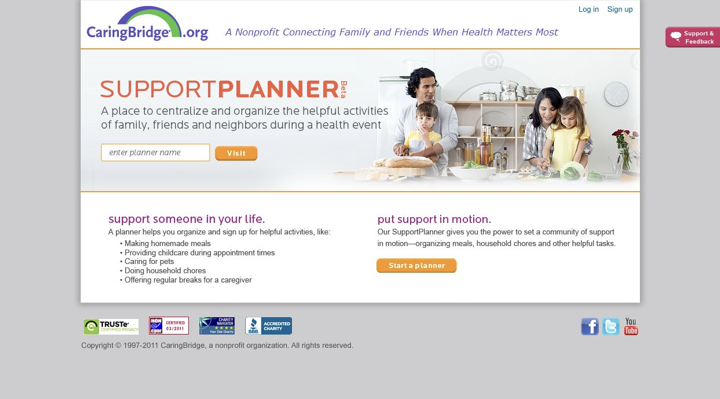
As CaringBridge’s second product, we worked through the entire product development process starting with research and customer discovery that led to a business case. Once the Board approved, we built and launched a product that virtualized the task and calendar experience many of our users were doing offline. We then connected the SupportPlanner to our users’ CaringBridge site where they were telling their stories in a secure environment.
Success metrics:
- 25% increase in community creation
- 25% expansion of donor base
- Secured first nonprofit grant in CaringBridge’s history of $50,000
HomeBack to Products CaringBridge - Replatforming Transition
Market Problem:
Founded in 1997, CaringBridge is a social platform for families experiencing health challenges who want to share their stories safely and securely. CaringBridge’s business model is a donor-driven nonprofit that relies on community members to be so engaged that they would help fund the platform.
As a 15-year-old platform, CaringBridge had not been fully updated and rearchitected since its launch. When the company decided a rebrand and repositioning was necessary, the product also needed to be updated to meet the new brand promise, but the existing technology could not support a facelift or provide major new features.
The biggest problem, beyond rebuilding a beloved product with 20+ million annual visits, was respectfully migrating existing communities.
Who’s it for:
Platform in transition
What we did:
Partnering with our Architect, we devised a plan that would reduce the risk of users rejecting a new user experience and allow for a firm end-of-life date for the old platform. Instead of a hard cutover for communities and users, we rebuilt the current experience with a “Faux” interface on our new infrastructure after extensive performance tests.
Next, we slowly rolled communities over to the new experience first voluntarily (getting feedback along the way), then new sites, and finally an orderly transition based on community activity. This allowed all sites to be moved off the old infrastructure, reducing costs, and ensuring the acceptance of the new normal by users.
Success metrics:
- Less than 3-month development timeline of the “Faux” experience assisted by known workflows and use cases
- 3-month transition timeline
- Continuity of important business metrics including activity and donations

.

HomeBack to ProductsZepol - Trade Data SaaS Product
Market Problem:
Imports into the United States are tracked by U.S. Customs and are public records. Until 2004, only one company (PIERS owned by the Journal of Commerce) had purchased this data and made it available to subscribers. Without a competitor, PIERS had grown into a thriving subscription business but was also complacent in its market position and unprepared for new entrants challenging its position.
Who’s it for:
Fortune 500 competitive intelligence librarians, logistics business development managers, and sourcing professionals
What we did:
Zepol was launched in 2004 and grew to be a significant competitor to PIERS in the $20 million trade data sector gaining approximately 15% market share over 6 years. To achieve this growth, we utilized a lean startup mentality throughout the entire business from product development, sales, marketing, and support.
Zepol was an early adopter of sales and marketing tactics that are now common for startups. Leads came primarily from search engine marketing and utilizing content, both on our blog and media partnerships established through sharing data. Our sales team embraced a cloud CRM, online demos, and a structured sales process to achieve both pipeline growth and bottom-of-the-funnel conversion.
Throughout my time at Zepol, I ran our marketing programs, support team, and directed our developers (managing our roadmap and defining features). This led to the establishment of a QA process and product marketing-driven launches.
Success metrics:
- Grew company revenue from $182k to $3.2m in 5 years
- Establish paid and organic marketing programs that delivered 50+ leads per month for the sales team
- Transformed product from a single developer’s vision to a customer-driven product with insight cited in dozens of publications each month

HomeBack to Products